Writing
The Windrush Generation
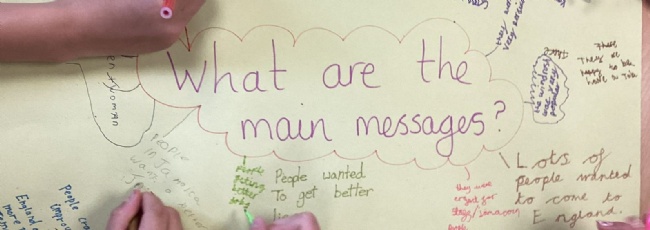 Penguins class have started a new writing unit by analysing historical evidence of the Windrush Generation
Research Skills in Writing and History
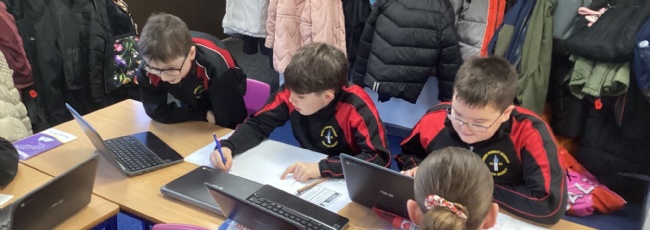 In Penguins Class, we believe that research skills are key to both English and History learning. This week, our students have been busy applying these skills in exciting ways across two subjects!
At Manor we view the acquisition of language skills to be of the utmost importance and so the teaching of all aspects of English is given high priority. Writing is integral to our children’s whole language experience; it is a crucial part of thinking and learning. This overview outlines the purpose, nature and management of the teaching of writing at Manor. It states how we deliver the writing elements of the English National Curriculum and the Early Years Foundation Stage as well as recent DFE guidance and subject reports for Literacy.
Intent:
At Manor, we aim for ALL our children to become confident, fluent and effective writers who are able to use a wide range of writing tools and skills that are taught and developed through their journey with us.
Implementation:
At Manor Primary Academy, we strive to ensure that every child sees themselves as a writer by following a book-based approach to learning. Books are incredibly powerful and versatile tools that open up countless opportunities. They not only provide a wealth of information, experiences, and knowledge but also support cultural, emotional, intellectual, social, and spiritual development. High-quality texts enhance comprehension, vocabulary, spelling, speaking, listening, and writing skills. Due to these significant benefits, Manor Primary has fully embraced a book-based approach to teaching English, making it the cornerstone of our curriculum.
At Manor Primary, English is taught through the Literary Curriculum, a book-centered approach created by the Literacy Tree. This curriculum places children’s literature at the heart of learning, immersing students in a literary world. By engaging with carefully planned writing sequences and spelling seeds, students develop a deep connection with the material, fostering meaningful and authentic contexts for primary English education.
As children engage with a diverse array of authors and explore various genres, including fiction, non-fiction, and poetry, they develop into critical readers and cultivate their own writing style. During their time at Manor, pupils will delve into over 200 literary texts and encounter the works of over 150 distinct and influential authors.
To ensure the curriculum is thoroughly integrated across the school, pupils participate in both an English lesson and a spelling lesson/investigation each day, each focusing on a different book. Every half-term centres around a specific theme, with connections made to the broader curriculum whenever possible. This approach allows pupils to explore the theme in greater depth and from multiple perspectives.
We employ a spiral approach to learning, enabling pupils to revisit and reinforce different aspects of the National Curriculum multiple times throughout the year. This method ensures comprehensive coverage of all National Curriculum requirements, including writing composition, reading comprehension, grammar, punctuation, vocabulary, spelling, and phonics — all within meaningful contexts.
*** Please note: after discussion with the writing lead, teachers may occasionally decide to plan alternative writing units that are not from the Literacy Tree schema, such as; cross-curricular writing opportunities, recounts after a visit or whole school writing units for enrichment and or assessment purposes. These changes will take into account prior learning, the impact of 'missing' a Literacy Tree unit and if the change enriches our already well planned writing curriculum.
Manor Writing Curriculum
- Swans Writing Long Term Plan
- Owls Writing Long Term Plan
- Penguins Writing Long term Plan
- National Curriculum English .pdf
For each writing unit, we will:
- Provide frequent opportunities to write.
Encourage children to write clearly, legibly and accurately with attention to punctuation, spelling and grammar. These will be corrected by the teacher during marking or immediate feedback. Pupils will correct these errors. - Provide regular modelling of the writing process.
- Provide regular modelling of making judgements about the style, format and choice of vocabulary, for a specific purpose, audience and genre.
- Provide regular modelling of drafting, revision and proof-reading, for instance using visualisers.
- Provide time for children to reflect on the writing process and refine their work.
- Provide regular opportunities for children to produce independent writing and Big Writes, which will be clearly identified as independent.
- Independent writing (Big Writes) will be assessed in a timely manner (within 5 days) against the agreed TAF or by using Fierte Assessment criteria.
- Deep mark independent writing with a positive comment.
- Set individual targets for writing and assist children in reviewing their targets (and setting personal ones where appropriate)
- Provide opportunities for children to focus on specific targets through ‘Instant Catch Ups’ (ICU) and interventions.
- Provide children with opportunities to share their writing.
- Encourage children to take responsibility for their own writing development and progress. Surround children with a print-rich environment that they have helped to create.
- Reward and celebrate children’s efforts and achievements in writing.
- Provide opportunities for cross-curricular writing.
- Provide a wide variety of texts which cater for children’s diverse interests and needs, and act as a stimulus to their own writing.
Writing in the Early Years Foundation Stage
At Manor Academy, Drawing Club is a magical part of the Early Years Foundation Stage (EYFS- Robins) curriculum, designed to spark creativity, imagination, and a love of storytelling in our youngest learners.
What is Drawing Club?
Drawing Club is a unique approach that blends drawing, storytelling, and early writing skills. It’s built on the principles of play, imagination, and language development. Each week, children are introduced to a rich and exciting storywork; this could be a traditional tale, a picture book, or even a short animation. From there, they explore characters, settings, and plot through drawing and mark-making.
How is it taught in EYFS?
In EYFS, Drawing Club is taught through short, engaging sessions that encourage children to think creatively and express their ideas visually and verbally. Teachers model drawing techniques and storytelling prompts, and children are invited to add their own imaginative twists. Vocabulary is introduced in a playful way, helping children to build language skills while having fun.
Children might be asked to design a magical door, invent a new character, or draw a scene from a story with their own ending. These activities support fine motor development, early literacy, and confidence in self-expression.
Why Drawing Club matters
Drawing Club nurtures a love of stories and helps children see themselves as authors and illustrators. It’s inclusive, accessible, and joyful—making it a firm favourite in our EYFS classrooms.
In addition to Drawing Club, we will ensure that our pupils in EYFS are encouraged to develop their fine motor skills, which are essential for pencil control and writing. Activities will include play dough, cutting, threading and using a range of tools. Children are encouraged to 'mark make' as they access a range of materials independently which are carefully planned to promote the development of writing skills. A wide variety of opportunities are provided for children to engage in writing activities including:
- Shared writing
- Role-play (e.g. an office or restaurant)
- Labels
- Recipes
- Lists
- Making books
- Writing letters
- Menus
Their efforts at this emergent writing stage are valued and praised and as their phonic knowledge and handwriting skills increase, this will be reflected in their writing.
Assessment of Writing
Children’s writing is assessed at least once half-termly from Reception using assessment grids (TAFs) and/or the Fierte Assessment writing documents, which are linked directly to the National Curriculum Programmes of Study for each year group. These assessments then inform our target setting and are used as the basis for our planning.
Celebrating writing
Positive reinforcement of good writing is conducted through use of stickers and rewards, stars of the week and through our Achievement System. Writing is displayed in classrooms and around the school site.
How We Teach Spelling
Effective spelling instruction is an integral part of our literacy curriculum, and we are committed to helping children develop strong spelling skills that will support their reading and writing. Here's how we approach spelling across Key Stage 1 (Swans) and Key Stage 2 (Owls and Penguins).
Spelling in Key Stage 1 (Swans)
In Swans, the foundation of spelling is built through a systematic and synthetic phonics approach. We focus on ensuring children understand the relationship between sounds (phonemes) and letters (graphemes) and how these are used to form words.
Our Approach:
- Daily Phonics Sessions (year 1): We use a structured phonics program (Little Wandle) to teach spelling patterns, blending sounds, and segmenting word or Daily Spelling Sessions (year 2): Using Little Wandle's Bridge to Spelling and Spelling units to teach spelling patterns.
- High-Frequency Words: Children learn to read and spell common words that do not always follow standard phonetic patterns (tricky words).
- Building Vocabulary: Spelling is integrated with reading and writing activities to expand vocabulary.
- Multi-Sensory Techniques: We employ games, visual aids, and hands-on activities to make learning engaging and memorable.
Assessment and Support:
- Regular assessments help identify children who need additional support.
- Tailored interventions ensure no child is left behind.
Spelling in Key Stage 2 (Owls and Penguins)
As children progress to KS2, spelling instruction becomes more advanced, focusing on rules, exceptions, and the etymology of words.
Our Approach:
- Explicit Teaching of Spelling Rules: Lessons include prefixes, suffixes, homophones, and commonly confused words.
- Weekly Spelling Lists: Words are grouped by patterns or themes, and children practice them through a range of activities.
- Spelling in Context: Children are encouraged to apply their spelling knowledge in written work across all subjects.
- Word Origins and Morphology: We explore root words, prefixes, and suffixes to deepen understanding and expand vocabulary.
- Interactive Strategies: Spelling games, puzzles, and online resources make practice fun and engaging. Peer and self-assessment activities help develop independent learning.
- Assessment and Monitoring: Regular spelling tests and informal assessments track progress. Teachers provide constructive feedback to help children improve.
KS2 will be trialling a mastery approach to spelling this term using the plans and resources from https://emile-education.com which fit with our whole school approach to spelling. Mrs Armstrong will collect views from pupils, parents and teachers at the end of the term.
Handwriting
Handwriting is a fundamental skill that supports children’s learning across the curriculum. At Manor, we place great importance on teaching handwriting in a clear, consistent and developmentally appropriate way, helping children to become confident, fluent writers right from reception and continue as they move through the school.
Our approach is guided by the expectations of the National Curriculum, which emphasises correct letter formation, good posture and grip, and increasing fluency and speed as children progress through Key Stages 1 and 2.
Handwriting in the Early Years (Reception- Robins Class)
In Reception, handwriting development begins with building the physical foundations for writing. Fine and gross motor skills are developed through a wide range of play‑based activities such as dough disco, threading, construction, painting and mark‑making.
We teach children correct letter formation using the Little Wandle letter formations, which ensure:
- Letters are formed correctly from the very beginning
- Movements are consistent and easy to remember
- Bad habits are avoided before they become embedded
This year, we have introduced the Little Wandle handwriting lessons in Reception. These short, structured sessions explicitly teach:
- Correct posture, pencil grip and paper position
- How to form letters accurately using clear verbal prompts
- Confidence and pride in early writing
Handwriting is always taught alongside play, exploration and creativity, ensuring it feels purposeful and enjoyable rather than pressured.
Handwriting in Key Stage 1 (Swans Class)
As children move into Year 1 and Year 2, handwriting instruction becomes more structured while still remaining supportive and accessible.
We continue to use the Little Wandle letter formations consistently from Reception to Key Stage 1; this ensures continuity and a shared language for teaching handwriting across classes.
In Key Stage 1, children are taught to:
- Form all lower‑case and capital letters correctly
- Understand which letters are the correct size and orientation
- Leave appropriate spaces between words
- Increase control, fluency and consistency in their writing
As children’s confidence grows, they are encouraged to write more independently and for a range of purposes, applying their handwriting skills across the curriculum.
Building Towards Fluent Writing
The National Curriculum expects that by the end of Key Stage 1, most children will be able to write legibly and comfortably. Our structured handwriting approach supports children to meet these expectations by:
- Revisiting and reinforcing correct formation regularly
- Practising handwriting little and often
- Supporting children who need additional fine motor or handwriting support
By establishing strong foundations early, we prepare children well for the increased writing demands of Key Stage 2.
The strong foundations developed in Reception and Key Stage 1 continue to be built upon as children move through the school. In Key Stage 2, pupils are supported to develop joined handwriting, increasing fluency, consistency and speed while maintaining legibility.
By Upper Key Stage 2, children are encouraged to:
- Use appropriate joins confidently and consistently
- Write clearly and legibly at speed across all subjects
- Adapt their handwriting for different purposes, such as note‑taking, drafting and final pieces
Teachers continue to revisit key principles established through Little Wandle – including correct formation, posture and control – while supporting children to refine their individual handwriting style. Where needed, targeted support is provided to help pupils who require further practice or confidence.
This carefully sequenced approach ensures that handwriting supports learning rather than becoming a barrier, enabling pupils to focus on spelling, sentence structure and content as they prepare for the demands of secondary education.
How Parents Can Support Handwriting at Home
Parents can play an important role in supporting handwriting development. Simple ways to help include:
- Encouraging correct pencil grip when drawing or writing
- Providing opportunities for colouring, drawing and writing for fun
- Practising letter formation using Little Wandle prompts
- Supporting fine motor development through activities such as Lego, cutting, threading and playdough
Most importantly, celebrate your child’s efforts and progress -confidence is key to becoming a fluent writer.